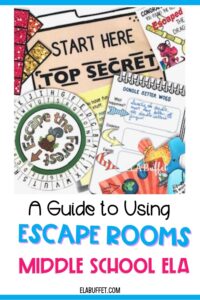
Escape rooms and breakout activities are highly effective for middle school ELA because they gamify key literacy skills like close reading, inference, and vocabulary, but in a format that feels like play. Building one requires a clear learning objective, a narrative frame, and layered puzzles. AI tools can help with concepts but can’t reliably produce the print-ready, curriculum-aligned puzzle logic that paper escape rooms demand.
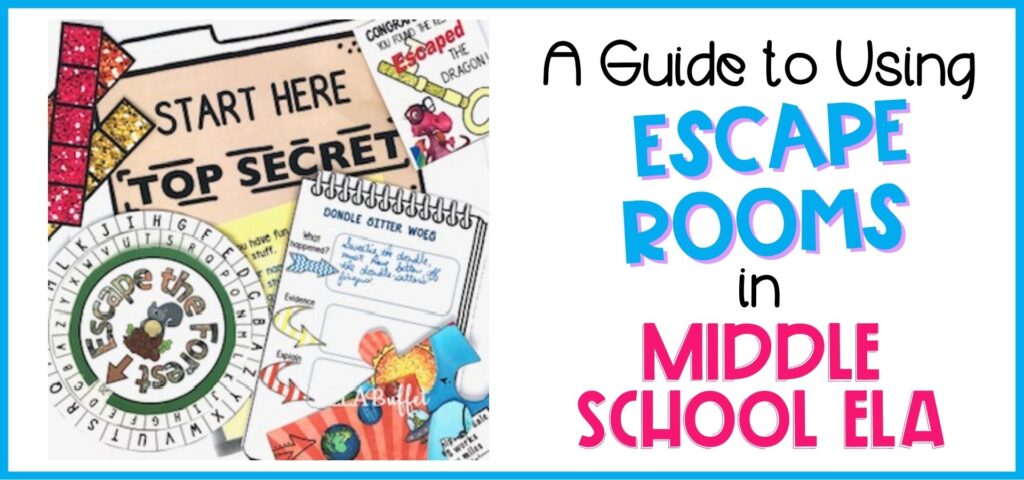
Picture it: your loudest class, dead silent, huddled over a clue like they’re helping the Knights Templar crack an ancient national mystery.
That was me last spring, watching my 7th graders lose their minds over a locked “vault” that was really just a wrinkled manila envelope. It was awesome.
The magic of a well-built escape room in middle school ELA is that it turns “do we HAVE to read this?” into “wait, don’t tell me the answer!”
Stick around, because I’m about to break down exactly why these breakouts work so well and how you can make them work for you too.
If you’ve never run a breakout activity before, the concept is simple: students work through a series of puzzles—each one tied to a real ELA skill—to “unlock” a final answer or outcome. No fancy technology required. A few envelopes, a combination of clues, and a good story frame can completely transform how your students engage with a text.
The research backs this up, and so does anyone who’s watched a reluctant reader suddenly become the most focused person in the room. In this post, we’ll dig into the why behind escape rooms in middle school ELA, walk through what actually goes into building one from scratch, and—honestly—have a frank conversation about why AI tools aren’t quite ready to do this work for you yet.
Why Escape Rooms Work So Well for Middle School ELA
Does gamifying ELA really increase student motivation?
Short answer: yes, and the reasons go deeper than “kids like games.” I’ve written about this HERE.
Self-determination theory, developed by psychologists Edward Deci and Richard Ryan, identifies autonomy, competence, and relatedness as the three core drivers of intrinsic motivation. A well-designed escape room hits all three. Students make choices about how to solve problems (autonomy), experience the satisfaction of cracking a clue (competence), and work alongside their peers toward a shared goal (relatedness).
When you gamify a reading activity, you’re not dressing up the curriculum with a costume. You’re restructuring the emotional experience of learning.
The stakes feel real. The timer creates urgency. And because the puzzles require actual comprehension to solve, students can’t fake their way through it. They have to read carefully, think critically, and communicate clearly. That’s ELA, packaged in a format that makes them forget they’re “doing school.”
How do breakout activities target key ELA standards?
This is where teachers sometimes hesitate. Fun is great, but does it actually check the boxes? When escape rooms are designed with intention, they absolutely do.
A single breakout activity can address multiple standards simultaneously:
- Close reading and textual evidence: Puzzles can require students to locate specific quotes or identify implied meaning before they receive a clue.
- Vocabulary in context: Cipher-based puzzles work beautifully here—students decode a message only after defining words from a passage.
- Author’s purpose and point of view: Narrative-framed escape rooms can ask students to consider why a character would leave a particular clue, reinforcing perspective-taking skills.
- Inference and figurative language: Multi-step puzzles that reward careful reading naturally push students toward higher-order thinking.
The key is that the puzzle depends on the skill. If a student can solve it without actually reading the passage, you’ve built a game, not a learning activity. The distinction matters.
Why do middle schoolers specifically respond so well to challenge and play?
Middle school is a tricky developmental window. No one knows that better than a middle school teacher.
Students this age are acutely aware of looking “stupid” in front of their peers, which makes traditional recitation or comprehension worksheets feel risky. Getting an answer wrong on a worksheet is public. Getting stuck on a puzzle in an escape room? That’s just part of the game.
The psychological safety of the game format lowers the stakes of being wrong. Students are more willing to take risks, try new interpretations, and ask each other for help—because it’s all part of solving the mystery. Teachers who run breakouts regularly will tell you the same thing: kids who never volunteer an answer in a whole-class discussion will argue passionately about puzzle logic with their group.
That’s not a small thing. That’s a shift in classroom culture.
Want ready-made escape rooms? Find them here.
What Goes Into Making a Paper Escape Room for ELA
Step 1: Start with a clear learning objective
Before you write a single clue, know exactly what skill you’re targeting. “Students will practice reading comprehension” is too vague. “Students will identify the central idea and supporting details in an informational text” gives you something to build puzzles around.
Your learning objective is the skeleton of the whole activity. Every puzzle should connect back to it. If you find yourself designing a fun puzzle that doesn’t require the target skill to solve, cut it or rework it.
Step 2: Build a narrative
The backstory or narrative is what transforms a worksheet into an experience. Students don’t just “answer questions”—they’re solving a mystery, breaking a code to stop a heist, unlocking a time capsule, or helping a fictional character escape a predicament.
A good narrative frame does a few things well:
- It creates stakes. Something has to matter. A countdown, a locked secret, a character in trouble.
- It justifies the puzzles. Why are there clues hidden in a passage? Because the villain left them, obviously.
- It fits the content. A breakout built around a historical fiction text might use a period-appropriate story frame. A poetry unit might center on a mysterious poet who left clues in their final manuscript.
The narrative doesn’t need to be elaborate. A single paragraph of setup—read aloud or printed on a “mission briefing” card—is often enough to get students fully bought in.
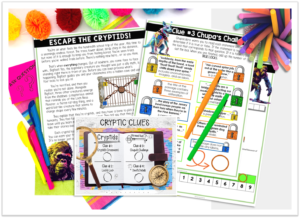
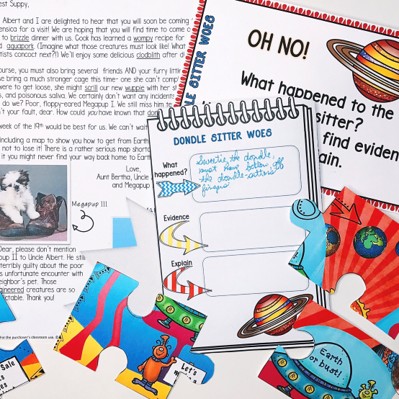
In the one below, students have to use context clues and inferences to find the map they need to return to earth.
Step 3: Design curriculum-aligned puzzles
This is the most time-intensive part of building an escape room, and also the most important to get right.
Curriculum alignment means the puzzle mechanic matches the learning goal. Here are a few formats that translate well to ELA:
- Cipher puzzles: Students decode a message after answering vocabulary or comprehension questions. Each correct answer corresponds to a letter or number.
- Sequence challenges: Students must arrange events or quotes from a text in the correct order to reveal a code.
- Inference locks: Students read a passage and must infer a detail that isn’t stated explicitly—the answer becomes the combination.
- Text evidence hunts: Students are given a claim and must locate the supporting quote that unlocks the next clue.
Aim for four to five puzzles per activity. Too few and the experience feels thin; too many and groups start to disengage before the finish line.
Step 4: Test it before you run it
Every teacher who has skipped this step has regretted it. Run through your own escape room before your students do. I usually bribe a family member to do this, but you can also ask a colleague to play the role of a confused 11-year-old.
Common issues to watch for:
- Instructions that make sense to you but are ambiguous to students
- Puzzles where the answer depends on an interpretation you haven’t accounted for
- Clues that are too easy (solvable without reading) or too hard (students hit a wall and disengage)
- Logical gaps where a group can get stuck with no path forward
Sometimes it’s helpful to add in a “hint system.” Include a card or a signal students can use to request help without feeling like they’ve failed. One or two hints per group is reasonable. It keeps the activity moving and prevents frustration from derailing the whole experience.
Why AI Isn’t Yet Equipped to Build Paper Escape Rooms
Let’s be honest: AI writing tools have genuinely changed what’s possible for teachers. Drafting discussion questions, generating differentiated reading passages, summarizing complex texts—these are real time-savers, and they work well.
Building a print-ready, curriculum-aligned paper escape room is a different problem entirely.
Here’s why AI falls short right now:
Puzzle logic requires closed-loop design. Every clue in an escape room must produce exactly one correct answer that unlocks the next step. AI-generated puzzles frequently contain ambiguities—multiple valid interpretations, unclear instructions, or answers that don’t map cleanly onto a code or combination. What feels logical in a language model’s output doesn’t always hold up when a real student tries to follow the steps.
Print formatting is genuinely hard to automate. A paper escape room isn’t just content. It’s a designed artifact. Clue cards need to be sized correctly, answer fields need to be clear, and the physical sequence of envelopes or stations needs to flow in a way that makes spatial sense to a group of students working at a table. AI tools generate text, not classroom-ready documents.
Curriculum alignment requires teacher judgment. AI can suggest activities, but it doesn’t know your students, your standards, your pacing guide, or the specific passage you’re using. The decision to make a particular puzzle depend on inferencing skills rather than literal recall—that’s a pedagogical call that requires context an AI doesn’t have.
Tested doesn’t mean functional. AI-generated escape rooms haven’t been run with actual middle schoolers. The gap between “this looks right on screen” and “this actually works in a classroom” is where most AI-generated activities fall apart.
This doesn’t mean AI has no role in the process. It can brainstorm narrative frames, suggest puzzle types, or help you draft a setup paragraph. But the actual design construction, such as aligning puzzles to standards, formatting for print, and testing for flow, all require a human hand.
Ready to Build Your First ELA Escape Room?
Escape rooms aren’t a shortcut to good teaching. They take time to build, they require thoughtful design, and they work best when every puzzle earns its place in the learning sequence. But when they’re done well, they do something that’s genuinely hard to replicate: they make students want to be inside the lesson.
Ready to take the plunge and create your first breakout activity? Start small. Choose one skill, craft three puzzles, write a one-paragraph narrative frame, and test it with a trusted colleague before unleashing it on your class. You don’t need a fancy set of padlocks or a dramatic soundtrack to pull this off. All you need is a clear learning objective, a story worth solving, and the courage to hand the challenge over to your students.
Then step back and watch what happens.
They’ll surprise you. Honestly, you might just surprise yourself too!
Frequently Asked Questions
What grade level are ELA escape rooms best suited for?
ELA escape rooms work well across grade levels, but they’re particularly effective in middle school (grades 5–8). Students at this age respond strongly to game-based challenge and peer collaboration, and the format provides psychological safety that traditional assessments don’t. With appropriate scaffolding, breakout activities can be adapted for upper elementary or high school as well.
How long does it take to run an ELA escape room in class?
Most paper escape rooms for middle school ELA run between 30 and 50 minutes, depending on the number of puzzles and the complexity of the texts involved. Factor in 5–10 minutes for the setup and narrative introduction, and leave time at the end for a debrief where students connect the activity back to the learning objective.
Do I need special materials or technology to run an escape room?
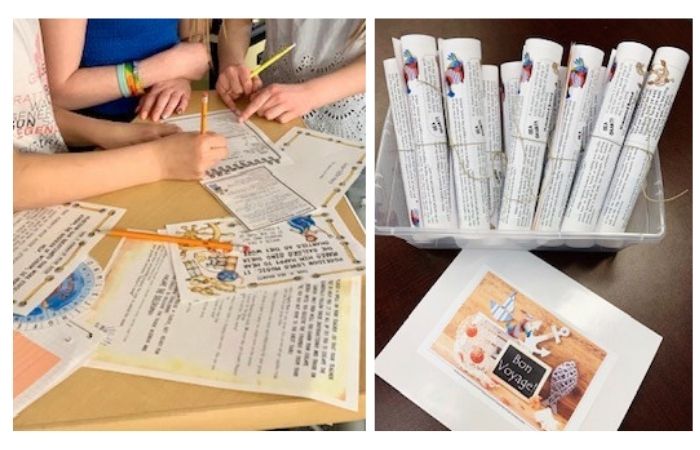
No. Paper escape rooms require only printed materials—clue cards, passages, answer sheets—along with envelopes or folders to organize the puzzle sequence. Some teachers use combination locks for added drama, but they’re not necessary. A “correct answer reveals the next clue” paper format works just as well and is easier to manage.
How do I differentiate a breakout activity for mixed-ability classrooms?
Build tiered versions of your clue cards—same puzzle structure, adjusted text complexity. You can also create “hint cards” that provide scaffolding for students who need more support, without changing the core challenge for others. Grouping students strategically (mixed-ability groups where stronger readers support peers) is another effective approach.
Can I use AI to help create an ELA escape room?
AI tools can support parts of the process—brainstorming narrative frames, generating vocabulary lists, or drafting a setup paragraph. However, AI currently struggles with the closed-loop puzzle logic, print formatting, and curriculum-specific alignment that a functional paper escape room requires. Teacher judgment and hands-on testing remain essential to producing an activity that actually works in the classroom.
What ELA skills work best as the basis for escape room puzzles?
Skills that require close, careful reading translate best. Strong candidates include: identifying textual evidence, vocabulary in context, inferencing, sequencing events, determining author’s purpose, and analyzing figurative language. The core rule is that the puzzle should require the skill to solve—if students can guess the answer without reading, the alignment has broken down.